
In the first of two strategic insights, we explore these trends and consider whether claimant age can reliably predict claim duration.
The lifecycle of a large loss claim invariably has a significant impact on overall indemnity spend. There are many factors which might potentially influence how long a claim takes to settle. One potential factor is the claimant’s age. We have categorised the claimant’s age at date of injury into three groupings: 0-17, 18-69 and 70+. In this first of two strategic insights, we focus on the relationship between median lifecycles when comparing the three age groups, and examine whether claimant’s age alone can be a reliable predictor of claim lifecycles.*
Claimants in the first age group are of course categorised as children/infants under the Civil Procedure Rules. Unless falling under the very rare exception permitted by CPR 21.2(3), infant claims require a litigation friend and settlement requires court approval. These factors typically add several months, often longer, to the overall lifecycle of a claim. Additionally, medical evidence often takes longer either to crystallise or to be sufficiently adequate to enable court approval. The median lifecycle for infant claims is 986 days (across all injury types).
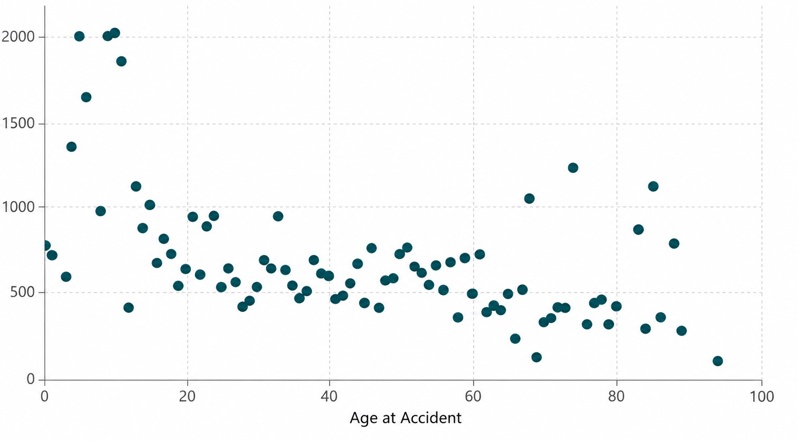
In the second age group, for claimants aged 18-69, the median lifecycle decreases to 572 days. This is approximately 42% shorter than for the infant claimant cohort. The scatterplot below** demonstrates a gradual reduction in lifecycle as claimant age increases. However, this data does not support claimant age alone being a reliable predictor for lifecycles within this age group. Instead, we view factors such as injury severity, prognosis and claimant solicitor litigation behaviour as being significantly more likely to influence claim lifecycle. However, age will indirectly influence factors which are drivers of lifecycle duration such as recovery periods, medical complexity, rehabilitation needs, future care requirements and settlement valuation complexity.
There is a substantial change compared to the second age group when the age of the claimant reaches age 70+. The trend for significantly decreased lifecycles accelerates sharply. The median claim lifecycle is 386 days. This 33% reduction compared to the second age grouping is a noticeable ‘cliff edge’. There are also more outliers, possibly influenced by fewer case numbers for older claimants.
It seems doubtful that the injuries sustained by claimants in this third age group would be significantly less severe or significant than in any other age group. We can speculate as to the reasons behind the overall trend of lifecycle reduction, such as generational attitude to litigation generally or an understandable fundamental desire to avoid protracted litigation. Whatever the reasons, settlement strategies can be formulated with this in mind. Our lifecycle data supports the proposition that claimants in this third age group may well be the most amenable to accepting a well-pitched early offer, even without complete, or any, medical evidence.
When comparing lifecycles within the three age groups, the overall trends detailed above are likely to accord broadly with Insurers’ own experiences. Our data indicates clearly that age alone should not be treated as a wholly reliable or determinative predictor of lifecycle. However, our data analysis reveals the lifecycle relationship between the three age groupings, with median lifecycle reducing materially from infant claimants to adults, and then reducing again significantly once claimants reach 70+. This can assist insurers with guiding settlement strategies, reserving of legal costs and other matters relating to predicting claim lifecycles.
Our second strategic insights article on this subject will follow in due course, in which we delve deeper into the data within the three age groupings.
Make more informed decisions with PREDiCT Large Loss
Harness the power of data-driven insights to improve claims outcomes. Weightmans’ PREDiCT Large Loss combines predictive analytics with specialist expertise to support more accurate reserving, proactive settlement strategies and reduced claim lifecycles.
